

Table of Contents
- What Makes a Deshedding Tool Work on Thick Coats
- Comparison Table: Deshedding Tools for Thick Coats
- 1. Pet Grooming Rake: Best for Dense Double Coats
- 2. Large Deshedding Brush for Pets: Best Everyday Option
- 3. Steamy Cat Brush: Best for Tangles and Knots
- 4. Plush Hound Hair Remover Mitt: Best for Sensitive Skin
- 5. Plush Hound Spray Gloves: Best for No-Rinse Cleaning
- 6. Plush Hound Bathing Glove: Best for Bath Time
- How Often Should You Deshed a Thick-Coated Dog?
- Undercoat Rake vs Deshedding Tool: What's the Difference?
- Frequently Asked Questions
Last Updated: September 14, 2026
What Makes a Deshedding Tool Work on Thick Coats
The best deshedding tool for thick coats reaches the undercoat without scraping the skin, and that single requirement eliminates most of what's sold as a deshedding brush. A deshedding tool is a grooming implement designed to remove loose hair from the undercoat, the dense insulating layer beneath the topcoat, before it sheds onto your floors. On a double-coated breed, the wrong tool skims the surface, pulls live hair, or irritates skin that was already sensitive.

The problem is rarely the owner's technique. It's that most rakes and brushes are built for short, single coats and simply cannot penetrate a thick undercoat.
Three factors separate a tool that works from one that doesn't:
- Tooth depth and spacing determine whether the pins reach the undercoat or glide over it
- Pin finish decides whether the tool glides or scrapes, which is the difference between a calm dog and a stressed one
- Handle control matters more than most reviews admit, because a slipping grip causes the pulling owners blame on the tool
Below, we break down six tools that handle thick coats properly, with the trade-offs of each stated plainly.
Comparison Table: Deshedding Tools for Thick Coats
| Tool | Price | Best For | Coat Type | Handle Style |
|---|---|---|---|---|
| Pet Grooming Rake | £12.89 | Dense double coats | Thick, long | Ergonomic non-slip |
| Large Deshedding Brush | £10.78 | Everyday maintenance | Medium to thick | Handheld |
| Steamy Cat Brush | £30.99 | Tangles and knots | Long, prone to matting | Handheld |
| Hair Remover Mitt | £15.40 | Sensitive skin | All lengths | Glove |
| Spray Gloves | £15.40 | No-rinse cleaning | All lengths | Glove |
| Bathing Glove | £12.40 | Bath time | All lengths | Glove |
1. Pet Grooming Rake: Best for Dense Double Coats
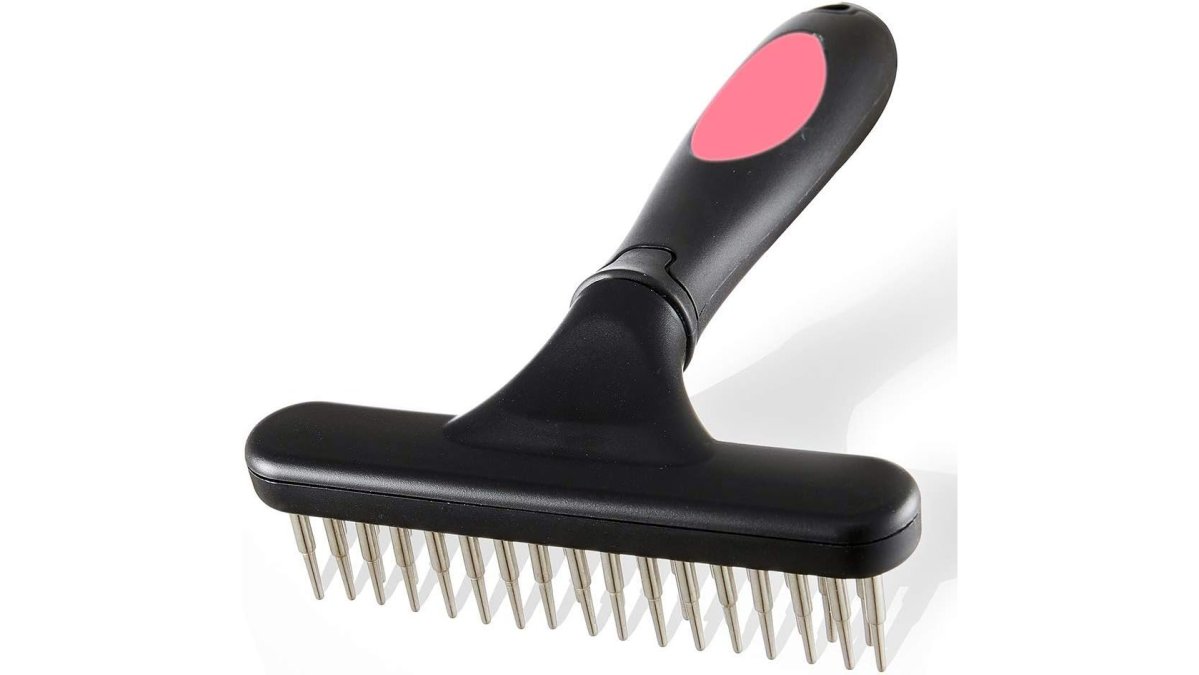
If your dog has a genuine double coat, this is where to start. The Pet Grooming Rake uses fixed double-row pins that reach through the topcoat and lift dead undercoat hair rather than dragging across the surface. Fixed pins matter: they don't rotate or flex away when they meet resistance, so the teeth actually do the work instead of skipping over the densest patches.

The ergonomic handle and non-slip grip are not marketing filler. A rake that shifts in your hand forces you to grip harder, and that tension travels down the tool into your dog's skin. The lightweight build keeps sessions comfortable for both of you.
Breeders and groomers commonly reach for this style of rake on collies, Golden Retrievers, St. Bernards, Siberian Huskies, Newfoundlands, Chow Chows, terriers, and schnauzers. The pins are sturdy enough for daily use, and the coat tends to look shinier within a week or two of consistent sessions.
Where it falls short: a fixed-pin rake is unforgiving on mats. If the coat has already clumped, work those areas out first or you'll pull.
2. Large Deshedding Brush for Pets: Best Everyday Option
For owners who want one tool by the door and five minutes a day, the Large Deshedding Brush for Pets is the practical pick. It's built for regular, light passes rather than deep undercoat extraction, which suits medium to thick coats that need maintenance rather than a full strip-out.
The upgraded ABS construction feels more solid than the price suggests, and it comes in Noble Pink and Moonlight White as premium comb versions, plus a Cherry Pink silicone comb as a set. The silicone option is the gentler of the two, which makes it a reasonable starting point for a dog that flinches at metal.
Honest limitation: on a truly dense undercoat, this brush will not replace a rake. It manages surface shedding well and keeps the topcoat tidy, but it doesn't reach as deep. Use it between rake sessions, not instead of them.
3. Steamy Cat Brush: Best for Tangles and Knots
Cats and knot-prone coats need a different approach, and steam changes the equation. The Steamy Cat Brush is a 3-in-1 grooming comb that combines hair removal, light steam cleaning, and massage in a single handheld tool. The steam softens fur slightly as you work, which makes knotted sections easier to separate without the yanking that sends a cat bolting under the bed.

The rounded tooth ends are the detail that matters most here. Sharp pins on a cat's thin skin cause scratches, and one bad session can undo weeks of trust-building. Rounded ends glide instead of catching.
It works on dogs as well as cats, and regular use tends to leave the coat healthier and shinier. The trade-off is price: at £30.99 it's the most expensive tool in this list, and it's a maintenance and detangling tool rather than a heavy-duty undercoat rake. For a cat with mild matting, it's the most considerate option here.
4. Plush Hound Hair Remover Mitt: Best for Sensitive Skin
Some pets will never accept a metal tool, and forcing the issue is a losing battle. The dual-sided Hair Remover Mitt uses soft silicone bristles on one side and mesh fabric on the other, so you're stroking your pet rather than combing them. Most anxious animals accept it because it feels like stroking.
The build is sturdier. Breathable mesh fabric and TPR material make it thick, abrasion-resistant, and it holds up to frequent use without the bristles flattening. Flexible wrist cuffs mean no straps to fiddle with and no hair catching in the seams.
It handles all fur lengths across small, medium, and large cats, and it doubles as a massage tool. The catch: silicone bristles collect loose surface hair, not deep undercoat. For a sensitive dog with a moderate coat, that's a fair exchange. For a Husky in blowing season, pair it with a rake.
5. Plush Hound Spray Gloves: Best for No-Rinse Cleaning
A quick tidy-up between full grooming sessions is where the Spray Gloves earn their place. The set pairs a grooming glove with a sprayer, so you can dampen the coat and lift loose hair and surface dirt without a bath. The glove measures 22 by 19.5 by 5 cm and runs on a 150mAh built-in battery charged at 5V, which is ample for short sessions.
Available in black, pink, and white, it suits owners who want grooming to fit into a two-minute window rather than a scheduled hour. The spray does the loosening; the glove does the collecting.
The limitation is straightforward: this is a freshening tool, not a deshedding tool. It won't clear an undercoat, and anyone expecting it to will be disappointed. Treat it as the tool you reach for on a muddy Tuesday.
6. Plush Hound Bathing Glove: Best for Bath Time
Bath time is the one moment when loose undercoat hair releases easily, and the Bathing Glove is designed to capture it right there. The adjustable glove fits either hand, and the soft material works shampoo through the coat while lifting hair and stains at the same time. It measures 26 by 16 cm and weighs 100g, so it stays comfortable through a full wash.
For pets that find bathing stressful, the massage action helps. You're not adding a separate grooming step at the end of a bath, which means less handling and a shorter ordeal overall.
What to watch for: it's a washing aid, not a substitute for a proper deshedding session once the coat is dry. Its real value is reducing how much hair ends up down the plughole and how much you have to clear afterwards.
How Often Should You Deshed a Thick-Coated Dog?
Most thick-coated dogs need deshedding two to three times a week, with daily sessions during seasonal coat blow (vcahospitals.com). Double-coated breeds shed heaviest twice a year, and that's when undercoat rakes earn their keep (Excessive Shedding in Dogs: Why Is My Dog Shedding So Much?). In between, short maintenance sessions prevent the build-up that turns into matting.
The rule that matters: little and often beats long and rare. A ten-minute session your dog tolerates is worth more than a forty-minute one that ends in a struggle.
Undercoat Rake vs Deshedding Tool: What's the Difference?
An undercoat rake is a type of deshedding tool, but not every deshedding tool is a rake. Rakes use rigid, widely spaced pins to reach the undercoat directly, which suits dense double coats. Deshedding brushes and gloves use finer bristles to collect surface and mid-coat hair, which suits maintenance and sensitive animals.
Match the tool to the coat, not the other way round. A rake on a short single coat scratches skin. A soft brush on a Husky in spring does almost nothing.
Frequently Asked Questions
What is the best tool for a dog with a very thick double coat?
A double-row undercoat rake is the most effective starting point for thick double coats. Its fixed pins reach through the topcoat to lift dead undercoat without pulling on the skin. For dogs that dislike metal tools, a silicone mitt or glove removes loose fur more gently. Many owners keep both: a rake for heavy seasonal shedding and a mitt for weekly maintenance and sensitive areas.
How often should you use a deshedding tool on a thick-coated dog?
Most thick-coated dogs need deshedding two to three times a week during heavy shedding seasons, typically spring and autumn. Outside those peaks, once or twice a week keeps loose fur under control. If your dog has sensitive skin, start with one short session and build up gradually. Stop if you notice redness or your dog pulls away, and try a gentler silicone option instead.
Do deshedding tools damage a dog's topcoat?
A well-designed deshedding tool removes loose undercoat without cutting the topcoat. Damage happens when tools have sharp blades or are pressed too hard against the skin. Rakes with rounded pins and silicone mitts are safer choices for thick coats. Always work in the direction the fur grows and avoid digging into the coat. If you see broken guard hairs after grooming, switch to a gentler tool.
What is the difference between an undercoat rake and a deshedding tool?
An undercoat rake has fixed metal pins that reach deep into the coat to lift dead undercoat. A deshedding tool often refers to brushes, mitts or gloves that remove loose fur from the surface and mid-coat. Rakes suit dense double coats; mitts and gloves work well for sensitive skin and shorter sessions. Many owners use a rake first, then a mitt to catch remaining loose hair.
Can I use a deshedding tool on a cat with a thick coat?
Yes, but choose a gentler option than you would for a dog. Silicone mitts and soft brushes work well on cats with thick coats because they remove loose fur without pulling. Steam brushes can help with tangles, though some cats dislike the moisture. Keep sessions short, around five minutes, and stop if your cat becomes stressed. Never force a tool on a cat that is clearly uncomfortable.