

Table of Contents
- Recognising the Signs of Grooming Anxiety in Dogs
- Desensitisation Techniques for Dog Grooming
- Setting Up a Calm Grooming Space
- Quiet Dog Grooming Tools That Reduce Stress
- How to Calm a Dog for Nail Trimming
- How to Groom Anxious Dogs Step by Step
- When to Stop and Seek Help
- Conclusion
- Frequently Asked Questions
Last Updated: September 11, 2026
Recognising the Signs of Grooming Anxiety in Dogs
Grooming anxiety in dogs is a stress response triggered by the sounds, sensations, or restraint involved in brushing, clipping, and bathing. It shows up long before a dog snaps or bolts.
The tell-tale signs are easy to miss if you are not watching for them. Lip licking, yawning, and turning the head away are early signals (avma.org). A tucked tail, flattened ears, and a rigid body follow. By the time a dog is trembling or trying to bite, the stress has been building for minutes.
What most owners get wrong is treating the first growl as the problem rather than the message. That growl is the last clear warning you get. This guide from Plush Hound walks through the full sequence, from spotting those early cues to building a grooming routine your dog can actually tolerate.
Desensitisation Techniques for Dog Grooming
Desensitisation techniques for dog grooming work by pairing each tool and sensation with something pleasant, in tiny doses, over weeks rather than days. The goal is familiarity, not tolerance.
Start with the tool switched off. Let your dog sniff it, then reward. Repeat across several short sessions.
The sequence that works in practice:
- Show the tool, reward, put it away
- Touch the tool to a neutral body part for one second, reward
- Touch the tool to a sensitive area like a paw, reward
- Switch the tool on in another room, reward calm behaviour
- Switch it on nearby, reward, stop
- Use it for a few seconds of real grooming, reward, stop
Keep sessions to two or three minutes. End on a success, even a small one. A common mistake is rushing to step six in a single afternoon because the first five went well.
Setting Up a Calm Grooming Space
Where you groom matters as much as how. A calm grooming space is quiet, familiar, and free from the sounds and smells that spike anxiety.
Choose a room away from the front door, washing machine, and other pets. Put a non-slip mat on the surface so your dog is not scrambling for grip. That scrambling alone can undo weeks of progress.
Lighting should be soft but bright enough to see what you are doing. Have everything within arm's reach before you start, so you are not leaving mid-session to fetch a brush.
What most guides miss is the value of a familiar blanket. A towel that smells of home gives your dog something to anchor to when the clippers come out.
Quiet Dog Grooming Tools That Reduce Stress
Quiet dog grooming tools remove one of the biggest triggers in the room: noise. Clippers that whine, dryers that roar, and tags that jingle all raise arousal before you have touched your dog.
Look for tools with these qualities:
- Silent or near-silent motors on clippers and nail trimmers
- Soft-tipped bristles that glide through the undercoat without scraping skin
- Non-slip handles so you are not gripping hard, which dogs read as tension
- Rubber or silicone ID tags that stay quiet when your dog moves
That last point matters more than most owners realise. A metal tag clinking against a collar every time your dog shifts keeps anxiety simmering between sessions.
At Plush Hound, the focus is on exactly this kind of quiet, low-irritation equipment. Our products feature micro-contoured bristles on deshedding gloves shaped to reach the undercoat without pulling, silent nail clippers designed to remove the crunch sound, and custom-fitted silent ID tags to remove the constant jingle that keeps a nervous dog on edge.
If you are unsure whether a tool is genuinely quiet, test it in another room first. If you can hear it clearly through a closed door, your dog will hear it louder.
How to Calm a Dog for Nail Trimming
Nail trimming is the hardest part for most anxious dogs, because it combines restraint, a strange sensation, and often a sharp sound. The fix is to separate the steps and slow down.
First, handle the paws daily without any tool. Hold each paw for a few seconds, reward, release. Do this for a week before you pick up the clippers.
When you are ready, trim one nail per session. Reward, then stop. Build up to two, then three. Trying to do all four paws in one go is the single most common reason nail trims turn into a wrestling match.
Position matters too. Rather than pinning your dog, sit beside them on the floor with their paw resting on your knee. You are supporting, not restraining.
If your dog pulls away, let them. Wait a beat, then try again. Forcing the paw back teaches them that pulling away does not work, which makes the next attempt harder.
How to Groom Anxious Dogs Step by Step
Here is the full routine, in the order that keeps stress lowest.
Before you start: brush your dog when they are already tired, ideally after a walk. A tired dog is a calmer dog.
Step 1. Set up the space and let your dog settle on the mat. Reward calm behaviour before you pick up a tool.
Step 2. Start with the least sensitive area: the back and shoulders. Use slow, long strokes with a soft brush or grooming glove.
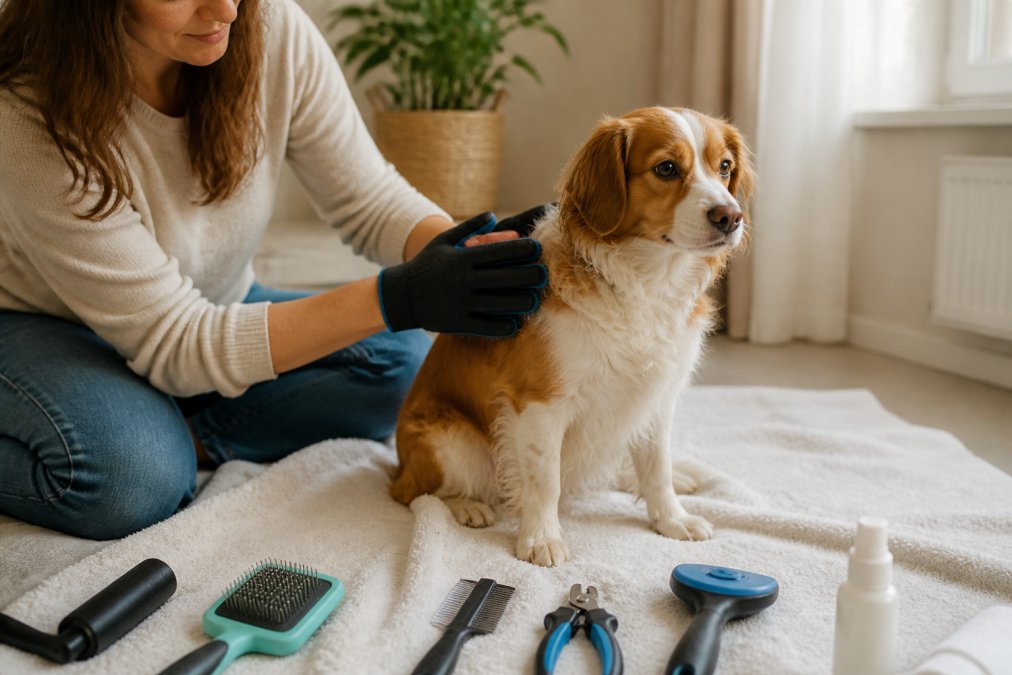
Step 3. Move to the flanks, then the chest, then the legs. Pause and reward every 30 seconds or so. Watch for early stress signals and stop before they escalate.
Step 4. Tackle the undercoat with a deshedding tool, working in the direction the fur grows. Short strokes, light pressure. If your dog flinches, you are pressing too hard.
Step 5. Finish with nails only if your dog is still relaxed. If not, leave nails for another day. There is no prize for doing everything at once.
Step 6. End with a reward and put the tools away where your dog can see you doing it. This signals that the session is over.
Keep the whole routine under ten minutes for anxious dogs. Short and frequent beats long and rare.
When to Stop and Seek Help
Stop immediately if your dog freezes, tries to bite, loses bladder control, or stops responding to treats. These are not signs to push through. They are signs that the current approach is not working.
For some dogs, the anxiety runs deeper than desensitisation can reach at home. If your dog has a history of fear-based aggression, has been traumatised by a previous grooming experience, or shows stress that escalates rather than improves over several weeks, speak to your vet.
A vet can rule out pain as a cause, since sore joints or dental issues often make dogs defensive about handling (vcahospitals.com). They can also advise on whether a referral to a qualified behaviourist is appropriate.
There is no shame in professional help. Some dogs need a slower, more structured plan than an owner can build alone, and getting that support early prevents the anxiety from hardening into a permanent response.
Conclusion
Grooming an anxious dog is a slow build, not a single fix. The owners who succeed are the ones who treat every calm session as a deposit and never push a stressed dog past their limit. Quiet tools, a settled space, and a routine that ends on a good note do more than any amount of treats handed out mid-struggle.
Plush Hound offers equipment for exactly this approach. Our deshedding gloves use micro-contoured bristles to lift the undercoat without pulling, our silent nail clippers are designed to remove the crunch sound, and our custom-fitted silent ID tags aim to end the constant jingle that can keep nervous pets alert. Get started with Plush Hound and turn grooming from a battle into a routine you both can live with.
Frequently Asked Questions
How do I desensitise my dog to grooming?
Start by introducing grooming tools during quiet, relaxed moments, not just when you need to groom. Let your dog sniff the brush or clippers, then reward calm behaviour with treats. Begin with just a few seconds of contact on a comfortable body part, gradually increasing time over days or weeks. Pair every session with something positive, like a favourite treat or gentle praise. This slow, consistent approach builds trust and reduces the fear response over time.
What are the best tools for grooming a noise-sensitive dog?
Choose tools designed to minimise sound and pulling. Silent nail clippers are designed to avoid the loud crunch that can trigger many dogs. Grooming gloves with micro-contoured bristles remove loose undercoat gently. Quiet identification tags also help, since metallic jingling can raise anxiety before grooming even starts. Test each tool briefly near your dog while they are relaxed, and reward calm behaviour before using it for a full session.
How can I keep my dog calm during nail clipping?
Handle your dog's paws regularly when you are not clipping, so touch becomes normal. Use silent nail clippers to remove the sound trigger. Clip just one or two nails per session if your dog is very nervous, then stop and reward. Hold the paw firmly but gently, and take breaks if you notice lip licking, yawning or pulling away. Over several short sessions, most dogs begin to tolerate the process with far less stress.
How long should a grooming session last for a nervous dog?
Keep sessions short, around five to ten minutes for highly anxious dogs. Break grooming into smaller tasks across several days rather than one long session. For example, brush one side one day and the other side the next. Always end on a calm note before your dog becomes overwhelmed. Short, positive sessions build confidence faster than pushing through a full groom when your dog is already stressed.