

Table of Contents
- Step 1: Gather the Right Tools and Prepare Your Space
- Step 2: Master the Hold and Identify the Quick
- Step 3: How to Safely Trim Dog Nails Without Cuts
- Step 4: How to Stop Dog Nail Bleeding If You Cut Too Short
- Step 5: Dog Nail Trimming for Anxious Dogs: Calm Techniques
- Step 6: How Often to Cut Dog Nails: A Simple Schedule
- Common Mistakes to Avoid When You Trim Dog Nails
- Frequently Asked Questions
Last Updated: 10 September 2026
Step 1: Gather the Right Tools and Prepare Your Space
Learning how to safely trim dog nails starts long before you pick up a clipper. The right preparation turns a wrestling match into a two-minute routine, and most owners skip it entirely.
The RSPCA's guidance on routine dog care is clear that nail care forms part of basic welfare, not an optional extra. Overgrown nails change how a dog stands and walks, and that affects joints over time.
Choosing the Best Quiet Dog Nail Clippers
The best quiet dog nail clippers are ones your dog barely notices. Scissor-style clippers with a sharp, coated blade produce far less noise than guillotine models, and the difference in your dog's reaction is immediate. A common mistake is buying the cheapest pair available. Blunt blades crush the nail instead of slicing it, which hurts and teaches your dog that clippers mean pain. Look for stainless steel blades, a non-slip grip, and a size matched to your dog's nails. Small breeds need small clippers; oversized blades make it harder to see the cut line. Keep styptic powder within reach before you begin, not after.
Setting Up a Calm Environment
Pick a spot your dog already associates with rest, not the bath or the vet's waiting room. Good lighting matters more than most people realise, because you need to see the pink quick inside pale nails. Lay a non-slip mat on a table or your lap, close the curtains if traffic noise sets your dog off, and have treats within arm's reach. A calming environment is not a luxury; it is the difference between a dog who tolerates nail trims and one who hides under the bed for an hour afterwards.
Step 2: Master the Hold and Identify the Quick
The quick is the living bundle of blood vessels and nerves running through the centre of each nail. Cutting into it causes pain and bleeding, which is why locating it before you cut matters so much.
For dogs with clear or white nails, the quick appears as a pinkish shadow running down the centre. Stop cutting roughly two millimetres ahead of it. Dark nails hide the quick completely, so use the underside of the nail as your guide: a small grey or chalky dot near the tip means you are close. Trim in thin slices rather than one big cut, checking the freshly exposed surface after each pass. As soon as you see a pale, solid centre appear, stop.
For the hold itself, tuck your dog's body against yours with one arm, keeping the paw steady but never squeezing. Your free hand holds one toe between thumb and forefinger. If your dog pulls away, release and reset rather than gripping harder. Forcing the issue teaches your dog that struggling works.
Step 3: How to Safely Trim Dog Nails Without Cuts
The core technique for how to safely trim dog nails is simple: small cuts, frequent pauses, and treats between every toe. Position the clipper so the blade sits perpendicular to the nail, then slice from the underside upwards. Angling the blade the wrong way flattens the nail and increases the risk of splitting.
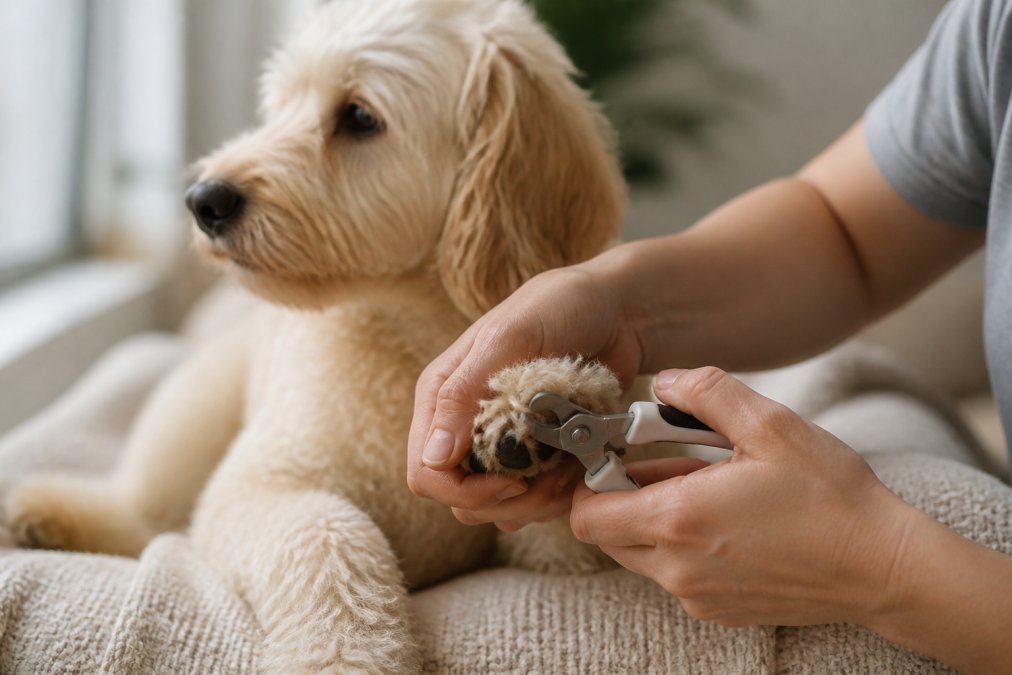
Work through one paw at a time rather than all four in one sitting. Many owners find that doing two nails a day, every day, beats a single stressful marathon session. If your dog has dewclaws, do not skip them; these nails sit higher on the leg and never touch the ground, so they grow unchecked and can curl back into the skin.
What most guides miss is the noise factor. Even a quiet clipper makes some sound, and a dog who has been startled before will react to the anticipation alone. Let your dog sniff the closed clippers, reward, then touch the clippers to a nail without cutting, and reward again. This desensitisation step takes a few sessions but pays for itself for years.
Step 4: How to Stop Dog Nail Bleeding If You Cut Too Short
Knowing how to stop dog nail bleeding is a skill every owner should have before it is needed. Press styptic powder or a styptic pencil firmly against the cut end for 20 to 30 seconds (vcahospitals.com). Silver nitrate sticks work in the same way. If you do not have styptic powder to hand, cornflour or a clean bar of soap pressed against the nail will slow the bleeding while you fetch a proper product.
Most minor nicks stop within a few minutes. Keep your dog calm and quiet, and avoid letting them lick the paw for the next half hour. If bleeding continues beyond ten minutes, or if the nail looks fractured rather than cleanly cut, contact your vet. A torn nail that exposes the quick needs professional attention, and trying to fix it at home usually makes it worse.
The emotional damage matters too. If you cut the quick, your dog remembers. End the session immediately on a positive note with a high-value treat, and give the nails a rest for a day or two before trying again.
Step 5: Dog Nail Trimming for Anxious Dogs: Calm Techniques
Dog nail trimming for anxious dogs follows one rule above all others: you cannot rush a nervous animal. Start by handling paws during relaxed moments, with no clippers in sight. Massage each toe gently for a few seconds, reward, and stop. Do this daily for a week before you introduce the tool.
When you do bring out the clippers, pair the sound with something your dog loves. Some owners find that a lick mat smeared with peanut butter keeps the dog occupied while they work through one paw. Others prefer to trim one nail per day and accept that the full set takes a week. Both approaches work. What does not work is pinning a frightened dog down, which erodes trust and makes the next attempt harder.
If your dog is genuinely panicked, a vet or a qualified groomer can show you handling techniques in person, and in some cases a vet can prescribe short-term support. There is no shame in asking. A dog who is terrified of clippers is not a training failure; it is a dog who needs a slower approach.
Step 6: How Often to Cut Dog Nails: A Simple Schedule
How often to cut dog nails depends on how much walking your dog does on hard surfaces. As a general rule, most dogs need a trim every three to four weeks, but active dogs who walk daily on pavements wear their nails down naturally and may need attention only every six weeks (akc.org).
| Dog Type | Typical Interval | What to Check |
|---|---|---|
| Active, walks on pavement daily | Every 4-6 weeks | Listen for clicking on hard floors |
| Mostly indoor or garden-only | Every 2-3 weeks | Nails curving towards the floor |
| Senior or less mobile | Every 2-3 weeks | Dewclaws and rear nails first |
| Puppies | Weekly check | Short, frequent trims build tolerance |
The click test is the simplest check. If you can hear nails tapping on a hard floor as your dog walks, they are too long. Nails should sit just above the ground when the dog stands still.
Common Mistakes to Avoid When You Trim Dog Nails
The single biggest mistake is cutting too much in one go. Thin slices are always safer than a confident snip, because you cannot put a nail back.
Other recurring errors we see:
- Using dull blades, which crush rather than cut and cause long-term nail damage
- Skipping dewclaws because they are awkward to reach
- Trimming all four paws in one session with a nervous dog
- Forgetting to reward between toes, so the dog learns only that clippers mean discomfort
- Stopping entirely after one bad experience, which lets the nails overgrow and makes the next trim harder
A common mistake is treating nail care as a monthly chore rather than a weekly habit. Short, frequent sessions keep the quick receded and the nails healthy, and they take less total time than one long battle.
If your dog has thick or sensitive paws and reacts badly to handling, the tools you use matter. Plush Hound's silent nail clippers are built for exactly this situation, cutting down the noise that triggers most anxious reactions. Paired with our micro-contoured grooming gloves for paw handling and deshedding, they turn a dreaded task into something closer to routine. The full range is designed around calm, low-noise care.
Frequently Asked Questions
How do I trim my dog's nails without hurting them?
Trim small slivers at a time, no more than 2mm, and stop before you reach the pink quick. Use sharp, quiet clippers and hold the paw firmly but gently. If your dog pulls away, pause and reward calm behaviour. Regular trimming keeps the quick short, making it easier to avoid cuts.
What should I do if I accidentally cut my dog's nail too short?
Stay calm and apply styptic powder or cornflour to the bleeding nail with light pressure. If bleeding persists after 10 minutes, contact your vet. Keep your dog quiet and offer a treat to reduce stress. For future trims, take off less length and use a bright light to see the quick clearly.
How often should I trim my dog's nails?
Most dogs need a trim every 3 to 4 weeks. Active dogs on hard surfaces may go 6 to 8 weeks, while less active dogs may need more frequent attention. Listen for clicking on hard floors; that sound means it's time. Regular trimming prevents overgrowth and keeps the quick from lengthening.
What are the best tools for trimming dog nails at home?
Quiet nail clippers designed for pets are ideal, especially for anxious dogs. Look for sharp stainless steel blades and a comfortable grip. Styptic powder is essential for safety. Avoid human nail clippers, which can crush the nail. Plush Hound offers silent clippers that reduce noise stress.
How can I make nail trimming a less stressful experience for my dog?
Start by handling your dog's paws daily and rewarding calm behaviour. Use silent clippers to avoid startling noises. Trim in a quiet room with soft lighting. Take breaks and never force it. For very anxious dogs, try a lick mat with peanut butter to distract them during the session.
Do I need to trim my dog's nails if they walk on concrete often?
Concrete can wear down nails, but usually not enough to skip trims entirely. Dogs who walk on hard surfaces may need less frequent trimming, but you should still check every few weeks. If you hear clicking on hard floors, it's time for a trim regardless of walking surface.
Nail trimming is one of those jobs that feels daunting until you have a system, and then it takes minutes. If your dog flinches at the sound of metal, the tool is often the problem, not your technique. Plush Hound makes quiet nail clippers and micro-contoured grooming gloves specifically for anxious and noise-sensitive pets, so handling and trimming stay calm from start to finish. Browse the Plush Hound range and build a grooming routine your dog stops dreading.